Custom website vs website builder: how do I choose
Choose custom vs a builder on blast radius, ownership, unique motion/CMS, AEO, and integrations. A builder is fine for simple local until those five flip.
William Spurlock Founder — Spurlock Studios 28 MIN
Choose custom vs a website builder on five axes: blast radius, ownership, unique motion or CMS, AEO, and integrations. A builder is the right product for simple local work — Google Business Profile plus a phone-first brochure — until those five start costing you shortlists, trapped content, or a path the theme cannot draw. Do not pick by which logo looks more premium. Pick by what breaks if you are wrong. This spoke sits under Websites That Feel Like Films. The sibling question — when the spend is justified — lives in when a custom website is worth it. This page is the how-to-choose table.
The short answer
- Score five axes, not a vibe. Blast radius, ownership, unique motion/CMS, AEO, integrations.
- Builders win simple local. Confirmation pages, one CTA, DIY edits, cash in ops.
- Custom wins when the site is a system. Original composition, structured editing, citeable answers, or jobs the app store cannot cover.
- Authored-on-builder is still a product. Webflow or Framer can be a template flip or commissioned work. Name which one you are buying.
- No invoice raises conversion by itself. The path, the proof, and the first viewport do.
| If most axes say… | Buy | Do not buy |
|---|---|---|
| Confirmation, DIY, cash in ops | Hosted builder | A film-grade rebuild |
| Craft + editors, export OK | Authored-on-builder | Theme setup labeled “custom” |
| Exit, odd contracts, hard performance | Custom code | Another app to fake the gap |
Custom website vs website builder: how do I choose?
You choose by scoring the job, not by collecting demos. I have shipped hundreds of production sites. The expensive mistake is treating “custom” and “builder” as fashion camps. They are products with different ceilings.
| Axis | Builder is enough when… | Custom (or authored-on-builder) when… | What “wrong” costs |
|---|---|---|---|
| Blast radius | Site confirms you exist; referrals and GBP close | Ads, booking, press, or wholesale hit the site first | Wasted media, missed bookers, a brand that undercuts the work |
| Ownership | You accept platform lock for a season | You need a clean exit, portable content, accounts in your name | Hostage logins, export gaps, a rebuild you already paid for once |
| Unique motion / CMS | Theme sections and rare DIY edits cover the jobs | You need original composition or editors who must not break layout | Sameness on the shortlist; a manager who wrecks the homepage |
| AEO | Titles, NAP, and a few FAQs on indexable HTML are enough | You need answer packets, entity control, and files at the root | Engines quoting a competitor; schema theater that never ships |
| Integrations | One embed or one native app does the job | You need signed webhooks, odd CRMs, or a stack the app store fakes | App pile, mobile breakage, “we’ll Zapier it” as architecture |
Decision list — pick the product by name before you take quotes:
- Hosted builder (Squarespace, Wix, similar) if four or five axes sit in the left column.
- Authored-on-builder (Webflow, Framer, similar) if craft and a visual CMS matter, and export risk is acceptable.
- Custom code (Astro or similar) if ownership, performance budgets, or integrations outgrow the platform.
- Stay put and spend elsewhere if the offer, photos, or follow-up are the real hole.
A logo is not a product. If a studio cannot tell you which row you are buying, you are shopping a reel.
What is blast radius on this decision?
Blast radius is how much of the business dies, stalls, or looks cheap if the site is the wrong product. It is not “do I like design.” It is “what happens on Tuesday if this URL fails its job.”
| Site job | Typical blast radius | Default product | Flip when… |
|---|---|---|---|
| Confirm you exist | Low — phone and GBP do the close | Builder | Peers look corporate and quote volume stalls |
| Phone-first local brochure | Low–medium | Builder | Service pages, mobile call paths, or proof at the fold start losing bids |
| Paid ads land on home | High — you are lighting the media budget | Authored or custom | The theme cannot hold the offer, proof, and CTA without junk |
| Artist EPK + tour + listen | High for bookers and press | Authored or custom | Linktree plus a pretty home cannot brief a buyer |
| Wholesale / premium product | High — packaging vs URL is a trust test | Authored or custom | The template undercuts the box on the shelf |
| Multi-audience (fans + bookers, buyers + sales) | High | Authored or custom | One theme grammar cannot draw two paths |
Score blast radius 0–2:
| Score | Meaning | Evidence you can point at |
|---|---|---|
| 0 | Confirmation page | Strangers call from GBP or referrals; the site is a receipt |
| 1 | Mixed | Some deals open on the URL; some do not |
| 2 | The site is the pitch | Ads, bookers, or buyers judge you here before they talk to you |
AllCity HVAC-shaped trades work often sits at 0–1 until service pages and mobile call paths become the bottleneck. Foxtide- or Arkayla-shaped artist work sits closer to 2 once booking and press are real jobs. Those are kinds of sites, not conversion percentages. I will not invent a lift for either.
Measure blast radius this week, not in a brand workshop:
- List every inbound of the last 30 days you can name: GBP, ads, Instagram bio, email signature, booker referral, walk-in.
- Mark which of those opened the website before a human conversation.
- If fewer than one in five did, you are probably a 0. If most paid clicks did, you are a 2.
- Write the failure sentence: “If this URL is down or looks cheap, we lose ___.” Fill the blank with a real object (a job, a hold, a wholesale account) or you are guessing.
- Date it. Revisit when you turn on ads or send the site to press — those two events jump radius without a redesign debate.
| Inbound | Opens site first? | If the URL fails, we lose | Radius note |
|---|---|---|---|
| Google Business Profile | |||
| Paid click | |||
| Social bio | |||
| Booker / buyer email | |||
| Referral |
If blast radius is 0, do not buy cinema. If blast radius is 2, a popular template is a recognizable costume in a room that punishes costumes.
How does ownership change the pick?
Ownership is a list of accounts, files, and exits — not a sentence in a proposal that says “you own everything.” Builders rent you a hosted editor. Custom (done honestly) leaves you a repo, a host, and credentials in your email.
| Artifact | Builder default | Custom default (when the SOW is honest) | Fail if… |
|---|---|---|---|
| Domain | Often registered in the platform if you are not careful | Registrar you control | The studio or the builder is the registrant |
| Content | Locked in modules; export is partial | Markdown, CMS, or a database you can dump | Proof lives only in unreachable blocks |
| Design | Theme + overrides that die with the theme | Components in a repo or a platform you can export | You cannot reconstruct the look off-platform |
| HTML / CSS / JS | Hosted; ZIP only on some paid plans | The repo | A contractor kept the only copy |
| Search Console / analytics | Easy to “set up later” | Properties you admin from day one | A freelancer “has the login” |
| Billing | Their card on the platform | Your card, your workspace | The site dies when they cancel |
Squarespace’s export notes are explicit: you get an .xml aimed at WordPress for pages, one blog, and some blocks. Design, CSS, store pages, and most special page types stay behind. Webflow’s code export is a ZIP of HTML / CSS / JS / assets on a paid Workspace — Site plans do not include it, and CMS databases do not ride along. Those are lease terms. Read them before you paint the walls.
Ownership checklist — check boxes with logins, not vibes:
- Domain registrant is you (or the company), not the designer
- Renewal mail hits an inbox you monitor
- Search Console and analytics are properties you admin
- You can export content this week without a support ticket
- You know whether code export exists on your plan, not a sales deck
- If the designer vanishes Friday, you can still publish Monday
Score ownership 0–2: 0 you accept the lease; 1 you own domain and Google properties but not the design; 2 you need a portable system. Cost anatomy of the authored side — labor, not a $20 login — is why custom sites cost five figures.
Run an export drill before you believe a sales sentence:
- Download whatever export the platform actually offers. Open the file. Note what is missing.
- Screenshot the billing page and the workspace members list.
- Confirm Search Console property ownership with a URL inspection, not a slide.
- Write the leave date you would tolerate (example: “end of next season”). If you cannot name one, you are not “fine with lock-in.” You have not thought about it.
- If step 1 produces a pretty ZIP that cannot rebuild the CMS, do not tell yourself you own a system. You own a snapshot.
Hostage logins are not a pricing tier. They are a failure mode you buy by skipping the list.
When does unique motion or a CMS force custom?
Unique motion is not “the template has a fade.” It is composition, type, timing, and scroll behavior designed as a system so the site does not look like every other install in the niche. A CMS forces custom (or a seriously modeled builder) when a human who is not the designer must publish without breaking the layout.
| Need | Builder usually covers | Builder starts fighting | Authored / custom |
|---|---|---|---|
| Motion | Preset section animations | You want a film-grade sequence that still respects prefers-reduced-motion | Motion budget, component states, performance cap |
| Homepage | Theme sections in a fixed order | The job needs a path the library cannot draw | Original compositions tied to one sentence job |
| CMS | Pages you edit rarely, yourself | A manager updates shows, jobs, or case studies weekly | Fields, not free-form blocks; locked chrome, editable facts |
| Collections | A blog and a few projects | Tour + EPK + merch + press as one model | Relational content, not stacked landing pages |
| Editors | You, on a laptop, once a month | Three people, a phone, a deadline | Roles, required fields, preview that matches prod |
Force-custom checklist (motion / CMS):
- You decline homepage ideas because “the template can’t”
- A non-designer broke layout in the last 90 days
- You keep a second tool (Notion, Google Doc, PDF EPK) for the real inventory
- Motion is part of the brand, not a toggle in a section
- Two content types must relate (dates ↔ venues, services ↔ cities, SKUs ↔ labs)
Three checks: you are past DIY section-swapping. Five: you are paying custom labor on a fighting theme.
| Score | Motion / CMS | What to buy |
|---|---|---|
| 0 | Presets + rare edits | Builder |
| 1 | Some original sections; still DIY | Authored slice on a builder |
| 2 | System + real editors | Authored-on-builder or custom code |
Theme animation is a costume. A motion system is a spec. If the proposal cannot name the spec, you are buying the costume at system prices.
How does AEO change custom vs a builder?
AEO is winning the cited answer — being the passage and the entity an engine can defend — not collecting a “custom” badge. Google’s AI features documentation is blunt: to show as a supporting link in AI Overviews or AI Mode, the page must be indexed and snippet-eligible. No extra technical door for custom shops. I have been SEO certified since 2021. The cert does not grant a secret schema type. It makes crawl boredom cheaper to diagnose.
| AEO control | Typical builder | Typical custom | What actually matters |
|---|---|---|---|
| Titles / meta | SEO panel | Same, if you remember | Unique titles that match the question |
| Indexable HTML | Theme HTML, often noisy | You control heading order and FAQ shape | Extractors read structure, not your invoice |
| schema.org | Apps / toggles (LocalBusiness, sometimes FAQ) | Exact FAQPage / BlogPosting you can defend | Valid JSON-LD that matches visible text |
| Entity / NAP | Easy to drift from GBP | You can lock one legal name across pages | Consistency with Google Business Profile |
robots.txt | Often limited or ticket-gated | A file in the repo | Crawl policy you can change this week |
llms.txt | Confirm you can publish a root file | Trivial | Briefing, not a sitemap dump — adoption is uneven |
Jeremy Howard’s llmstxt.org convention is a compact markdown briefing for inference-time context. Chrome’s Lighthouse llms.txt audit still treats a 404 as N/A because the file is optional. Do not buy custom because of llms.txt. Buy custom if you cannot publish the briefing and the answer pages you would put in it.
AEO checklist that is not theater:
- Homepage answers the primary question in the first viewport
- FAQs are real headings that end in
?, not an accordion widget that hides the question from HTML - One legal name, one NAP, matching GBP
- Search Console is yours; you can inspect a URL today
- You can ship
/llms.txtand edit robots without a platform lottery - You are not counting on FAQ rich results as the reason to rebuild — eligibility is narrow; the packet is still useful for humans and extractors
Score AEO 0–2: 0 titles + NAP on a clean builder page; 1 you need structured FAQs and entity hygiene the theme fights; 2 you need file-level crawler policy, answer packets, and HTML you can shape. Custom does not rank because it is custom. Creating helpful, people-first content is still the official bar.
If someone sells “custom = ChatGPT citations,” ask for the URL list the engine should cite. If that list does not exist, you are buying a story.
Do this on the builder before you use AEO as a reason to switch:
- Rewrite the homepage H1 so a stranger can repeat the offer.
- Add six genuine FAQs as visible headings that end in
?, with answers that match the visible text — not a widget that never makes it into HTML. - Align name, address, phone, and hours with Google Business Profile character-for-character.
- Verify Search Console. Fix what “URL is not on Google” actually says.
- Try to publish
/llms.txt. If you cannot, log that as an AEO constraint — not as proof you must rebuild tomorrow.
| Builder AEO move | Often enough | Not enough when… |
|---|---|---|
| Title / meta pass | Local confirmation site | You need a library of citeable service or release pages |
| Visible FAQ headings | A handful of real questions | Accordion JS hides the questions from extractors |
| NAP = GBP | Trades / SMB | Legal name drifts across artist, LLC, and storefront |
| Root briefing file | You can ship it this week | Platform will not host a file at /llms.txt and you actually need one |
AEO is a reason to change products when the platform blocks the packet. It is not a reason to change products because a vendor renamed SEO.
When do integrations break the builder?
Integrations break the builder when the job needs a contract the platform will not sign: a webhook you can authenticate, a CRM field the form cannot map, a booking flow the embed wrecks on a phone, or three apps taped together to fake one product.
| Job | Builder is usually enough | Builder starts lying | Custom (or a real integration plan) |
|---|---|---|---|
| Contact | Native form → email | Form → six tools with no owner | First-party form, CRM fields, spam plan |
| Booking | Calendly / Acuity embed | Embed fights mobile; no-show rules live in two places | Native flow or a well-owned embed with a fallback |
| Commerce | Platform store or a simple Shopify link | Merch + music + tour as one checkout fantasy | Honest split: store here, site there, or a real build |
| CRM / quotes | One Zap to a spreadsheet | “We’ll Zapier it” is the architecture | Idempotent jobs, signed webhooks, a human exception path |
| Artist stack | Listen links, a date list | Bandsintown + merch + EPK + mailing list all fighting the theme | Source of truth per job, site as the brief |
| Trades stack | Click-to-call, short quote form | Dispatch software the site pretends to be | Site does trust + call; ops tool does jobs |
Do not inventory apps you might buy. Inventory jobs:
- Write the job in one sentence (book a call, sell a hoodie, brief a buyer, start a quote).
- Name the system of record (calendar, store, CRM, spreadsheet).
- Name the contract (embed, native app, webhook, API, human paste).
- Test it on a mid-range phone.
- Count paid add-ons you already use to fake a missing feature.
| Add-on count | Interpretation | Next move |
|---|---|---|
| 0–1 | Platform still fits | Keep the builder; fix copy and proof |
| 2–3 | You are funding the gap | Time-box the stack; compare to a sprint |
| 4+ | The app store is your CMS | Stop adding SKUs; pick a system |
Score integrations 0–2: 0 one embed or native form; 1 two tools and a known owner; 2 you need contracts the builder will not give you. “We’ll connect it later” is how people ship a pretty site with a dead quote path.
The app pile is not an integration strategy. It is a monthly reminder you picked the wrong ceiling.
Webhook test — if you cannot complete this, you do not have an integration. You have a hope:
- Name the event (form submit, order paid, show added).
- Name the receiver (CRM, sheet, n8n, email).
- Send one real payload from staging. Confirm the receiver logged it.
- Send the same payload twice. Confirm you do not get two jobs, two tags, or two invoices.
- Fail the receiver on purpose. Confirm a human can see the miss.
If steps 3–5 are “the native app probably handles that,” score integrations at least 1. If you cannot name the event, score 2 and stop adding SKUs.
When is a website builder still the right pick?
A website builder is still the right pick for simple local work until the five axes flip. That sentence is the whole post in one line. Custom is not the grown-up badge. Custom is what you buy when the builder’s ceiling is already on the P&L.
Stay on Squarespace, Wix, or a similar hosted builder when most of this is true:
- The offer still changes this quarter
- GBP and referrals close more deals than the URL
- One CTA (call, email, or a simple form) already works on a phone
- You will not fund real photography or proof yet
- Nobody will maintain a CMS; you want rare DIY edits
- Cash should stay in ads, inventory, trucks, or payroll
- You can accept export limits for a defined season (write the date)
| Business shape | Builder is honest | Flip — “until it isn’t” |
|---|---|---|
| New local service | URL + hours + tap-to-call | Competitors look authored; you lose the shortlist of five tabs |
| Trades with strong reviews | Phone-first brochure aligned to GBP | Service pages and fold-level proof start deciding the bid |
| Solo consultant | One-pager | Productized offers need a library of pages |
| Early artist | Link-in-bio + simple home | Bookers need an EPK; tour needs a source of truth |
| DTC test | Builder commerce | Brand experience becomes the thing ads cannot apologize for |
Squarespace’s pricing page is built for that early job: a 14-day trial, hosting on the plan, annual billing if you want the discount. Wix’s plans page is the same category of purchase. I will not invent a market-share number for either. They are rational leases for a confirmation page.
Webflow’s May 2026 plan cleanup put a Premium Site plan at $25/month yearly ($39 monthly) with 20,000 CMS items. That is collection capacity. It is not “custom.” Framer’s public pricing (as of August 2026) lists Basic at $10/month and Pro at $30/month. Fine for a marketing site. Not a reason to call a template flip a brand system. List prices move; treat those figures as dated snapshots.
A good builder site with a real offer beats a neglected custom site every day of the week. Hundreds of production sites later, that is still the boring sentence. “Until it isn’t” is a date on a scorecard, not a personality.
Keep a flip log so “we’ve outgrown it” is evidence:
| Date | Axis that moved | Evidence | Still builder? |
|---|---|---|---|
| Blast radius | First ad campaign / first serious booker | ||
| Ownership | Could not export / lost a login | ||
| Motion / CMS | Editor broke home / second tool appeared | ||
| AEO | Needed a root file or answer library the theme fought | ||
| Integrations | Third paid add-on, or a webhook you cannot prove |
Re-score when a row gets a date. Do not re-score because a competitor launched a parallax hero. The competitor might still be on a template. Look at the jobs.
How does this choice affect conversion?
This choice affects conversion when the builder cannot draw the path, the proof, or the first viewport your buyer needs — not because custom is a conversion technology. I will not invent a lift percentage for a category, a city, or a portfolio name. Distrust anyone who will.
| Claim you will hear | What you can actually test | What you cannot honestly promise |
|---|---|---|
| “Custom converts better” | Five-second homepage test; path click-count on a phone | A universal % from a blog |
| “Builders kill conversion” | Theme fighting the primary CTA on mobile | “All Wix sites lose” |
| “Motion raises close rate” | Does motion hide the job, or make the job obvious? | Cinema as a revenue strategy |
| “SEO/AEO will 3x leads” | Indexable answers, internals, Search Console | A citation quota |
Run these four tests before you change products. They are directional. They are not a lab.
- Job sentence. Write the homepage job in one line. If you cannot, neither product will save you.
- Five cold viewers. What do you offer, who is it for, what next? Divergence is strategy. “Feels cheap next to X” is craft.
- Path inventory. Call, book, buy, listen, tour, quote — clicks to completion on a phone. Structural friction argues for authored layout. Copy friction argues for messaging on the platform you have.
- Cost-of-delay sketch. Deals influenced by the URL × your estimated close-rate gap vs peers × gross profit. If the sketch is fog, stay cheaper until measurement improves.
| Conversion hole | Fix on the builder first | Change product |
|---|---|---|
| Unclear offer | Copy, photos, proof | No |
| Slow LCP from a giant hero | Compress, cut apps | If the theme forces the weight |
| CTA below junk | Reorder sections | If the library cannot put the job first |
| Two audiences, one path | Sometimes a second page | When the theme grammar cannot split |
| Looks like every peer | Different template (weak) | Authored composition |
Core Web Vitals still use the same bars either way: Largest Contentful Paint within 2.5 seconds, Interaction to Next Paint under 200 milliseconds, Cumulative Layout Shift under 0.1 at the 75th percentile. Theme stacks fail those by shipping every app. Authored builds fail them with a 12MB hero named cinema. Neither failure is an argument for the other camp.
Conversion is a path. Custom is a way to build a path the library cannot draw. It is not a multiplier you can print on a proposal.
What should I ask a designer about this?
Ask which product they are selling, then make them fill the five-axis table with your jobs — not their reel. A designer who cannot name the product will sell you theme setup in a strategy costume.
Ask these out loud. Write the answers down.
- Are you quoting a template, a hosted builder, authored-on-builder, or custom code?
- Which of my five axes actually require that product? Show the score.
- What will I own on day one — domain, workspace, repo, Search Console?
- Who publishes next Tuesday, and which fields can they touch?
- How will AEO show up in HTML — FAQs, entities, files at the root — not as a line item called “optimization”?
- Which integrations are in v1, and which are a change request?
- What happens if I leave this platform in 18 months?
- What should I not buy from you yet?
| Question | Pass | Fail |
|---|---|---|
| Product name | One of the four, in writing | “We’ll figure out the stack in week two” |
| Axes | Your jobs mapped to the table | A moodboard and a vibe |
| Ownership | Account list with your email | “You own everything” with no URLs |
| CMS | A real edit in the demo | “It’s easy, we’ll train you later” |
| AEO | URLs, schema that matches visible text, Search Console owner | “We do SEO” |
| Integrations | Named contracts | “The app store has everything” |
| Exit | Export reality, not folklore | “You won’t want to leave” |
| Scope | v1 page list | “Unlimited revisions” |
Designer-call checklist:
- Product named before price
- Five-axis score filled with your evidence
- Ownership list, not a slogan
- One live CMS edit in the meeting
- Integration list with owners
- A written “not yet” — photography, offer, or follow-up before craft
If they cannot say “stay on the builder,” they are not advising. They are filling a pipeline. The hire-versus-DIY question is a different spoke; this one is product choice. Do not let a reel collapse them.
What usually fails first when you pick the wrong product?
The first failure is usually not “the site looks ugly.” It is a job the product cannot do, billed as a surprise three months later.
| Wrong pick | What fails first | What it costs | What to do instead |
|---|---|---|---|
| Builder after blast radius is 2 | Shortlist skip; “you look like everyone” | Deals you never hear about | Authored home + key paths, not a new template |
| Builder after CMS is 2 | Manager breaks layout; you hire a monthly wrestler | Custom labor with a worse ceiling | Structured fields; lock the chrome |
| Builder after integrations are 2 | Quote / book / buy path dies on mobile | Ads to a dead end | Stop adding apps; specify the contract |
| Custom while blast radius is 0 | Six-month homepage committee | Cash and calendar, empty pipeline | Builder + photos + follow-up |
| Custom with no ownership | Contractor-held workspace | You cannot publish or leave | Move accounts before you design |
| Custom sold as SEO | No titles, no redirects, no Search Console | You “lost SEO” and blame the stack | Hygiene in the brief; product second |
Concrete builder-too-long failure: you are paying a designer every month to fight Squarespace sections, stacking paid apps for a quote flow the form cannot do, and declining homepage ideas because the library said no. That is not thrift. That is a sprint you are financing on installment without a ceiling change.
Concrete custom-too-soon failure: pre-revenue, offer still moving, gorgeous site, no photography budget, nobody to edit, no customers. Strategy first. The site cannot teach you what people buy.
| Early warning | Ignore it and you get | Catch it and you do |
|---|---|---|
| “We’ll add the real booking later” | A pretty dead end | Booking in v1 or a labeled fallback |
| “SEO package” with no property | Unmeasured folklore | Search Console in your account |
| “Unlimited pages” | A CMS nobody will touch | A page job list |
| “Animations” before the fold’s job | Motion that hides the CTA | One sentence, then motion budget |
| “You own it” with their card on the workspace | A hostage | Billing cutover this week |
Wrong-product work fails at the job, not at the aesthetic. If you cannot name the job that will fail, you are not ready to choose a product.
How do I score the five axes in one sitting?
Score it once, on a timer, with evidence. Do not re-litigate brand identity. This is an operating rule from shipping hundreds of sites — not a published market study, and not a claim about category conversion rates.
Set 45 minutes. No moodboards.
- Write the homepage job in one sentence.
- Score blast radius 0–2 with the job table above. Note where deals actually start (GBP, ads, bookers, referrals).
- Score ownership 0–2 from the login list. If you cannot name the registrant, you are at least a 1.
- Score unique motion / CMS 0–2 from declined ideas, broken layouts, and second tools.
- Score AEO 0–2 from whether you need answer packets and file-level control, not from a fear of ChatGPT.
- Score integrations 0–2 from the job → system-of-record → contract list. Count paid add-ons.
- Sum 0–10. Date the page. Revisit when a signal flips — not when a designer posts a shot.
| Total | Product to buy | What not to buy |
|---|---|---|
| 0–3 | Hosted builder; spend on photos, copy, follow-up | A film-grade project to soothe ego |
| 4–6 | Authored slice (home + money paths) on a capable builder | A museum rebuild of every URL |
| 7–10 | Authored system — builder or custom code per ownership and integrations | Theme setup with a strategy costume |
Tie-breakers when the total sits on a fence:
- If ownership is 2, prefer custom code or a platform with a documented export you have actually clicked
- If motion/CMS is 2 and ownership is 0–1, authored Webflow/Framer is coherent
- If integrations are 2, do not let a visual CMS veto the contract
- If blast radius is 0, a high AEO score still might mean “write better FAQs on the builder,” not “rebuild”
Worked composite — not a client result, not a conversion claim. A local service shop: blast 1 (some quotes from the URL), ownership 0 (fine with the lease), motion/CMS 0, AEO 0 (titles + NAP), integrations 0 (tap-to-call). Total 1. Stay on the builder; spend on photos and the phone path. An artist who just hired a publicist: blast 2 (EPK is the brief), ownership 1, motion/CMS 2 (dates + press + listen), AEO 1, integrations 1. Total 7. You are in authored-system territory. The publicist does not need a new template. They need a kit that holds still.
Print the scores. The next designer meeting starts from that sheet. If they throw it out for a vibe, they are selling a different product than you asked for.
Authored builder vs custom code — which custom?
“Custom” is two products. Mixing them is how quotes become incomparable.
| Authored-on-builder (Webflow, Framer, similar) | Custom code (Astro or similar) | |
|---|---|---|
| What you buy | Original compositions + visual CMS on a host | Repo, performance budget, integrations, exit |
| Who edits | Marketing, with training, in the canvas or CMS | Whoever you give a CMS — often a structured one you designed |
| Ownership | Platform lease + whatever export the plan allows | The repo, if you own it |
| AEO files | Possible, with plan and discipline | Default: files in the project |
| Integrations | Apps + embeds + some webhooks | Whatever you are willing to maintain |
| Buy this when | Craft + editors, export risk acceptable | Blast radius + ownership + integrations are high |
| Fail mode | Template grammar sneaking back in; export surprise | Scope that never ships; nobody to maintain |
Procedure to pick the custom flavor:
- If the five-axis total is 0–3, stop. You are not in this section.
- If editors must work visually and export is acceptable, authored-on-builder.
- If you need signed webhooks, a hard JS budget, or a host you can leave without a ZIP ritual, custom code.
- If you only need a prettier theme, you are back in builder land. Do not call it custom.
Webflow and Framer are not “not custom” because they are visual. Authored work there is still custom design/build labor. A template install on either is still a template. The tool does not decide. The SOW does.
Pick the smallest product that clears the axes you actually scored. Then stop arguing with the other camp’s logo.
FAQ
Custom website vs website builder: how do I choose?
Score blast radius, ownership, unique motion/CMS, AEO, and integrations from 0–2 each. Low totals stay on a hosted builder. High totals buy an authored system — on a builder or in custom code — not a new template. Do not choose by which logo looks more premium.
How do I measure whether the custom-vs-builder choice is working?
Measure the jobs you scored: can a stranger name the offer, complete the primary CTA on a phone, and can you publish without breaking layout. For AEO, inspect cited answers and Search Console — not vanity traffic. If you still decline ideas because “the template can’t,” or you are stacking apps to fake a path, the choice is already failing.
What usually fails first when teams try this?
The job the product cannot do. Builder-too-long fails as shortlist sameness, broken CMS edits, or a dead booking/quote path. Custom-too-soon fails as a six-month homepage committee with no customers. Ownership failures show up when someone needs to publish and the keys are in the wrong inbox.
How long does this take to show results?
A builder confirmation page should be live this month; you will know in weeks whether GBP and the phone path work. An authored slice shows craft and path changes as soon as the money URLs ship — not after a year of “brand exploration.” Citation and search effects follow indexable pages and patience; they are not a week-one trophy.
What should I skip if I only have a week?
Skip the rebuild. In a week: write the homepage job, fill the five-axis scores, screenshot five peer tabs, confirm who owns domain and Search Console, and kill one app you do not need. If the total is 0–3, spend the week on photos and copy on the builder you have.
When is this not worth doing yet?
It is not worth a custom project while the offer still changes monthly, you have no proof to put on the page, and blast radius is still a confirmation URL. Stay on the builder. Re-score when a signal flips — lost shortlists, a manager who cannot edit, or an integration the app store cannot cover.
CTA
If the five-axis sheet says the builder’s ceiling is the job, stop arguing with the theme and scope the system.
Explore /websites or book a Website sprint at /contact?intent=websites-sprint.
What questions does this article answer?
- Custom website vs website builder: how do I choose?
- Score blast radius, ownership, unique motion/CMS, AEO, and integrations from 0–2 each. Low totals stay on a hosted builder. High totals buy an authored system — on a builder or in custom code — not a new template. Do not choose by which logo looks more premium.
- How do I measure whether the custom-vs-builder choice is working?
- Measure the jobs you scored: can a stranger name the offer, complete the primary CTA on a phone, and can you publish without breaking layout. For AEO, inspect cited answers and Search Console — not vanity traffic. If you still decline ideas because “the template can’t,” or you are stacking apps to fake a path, the choice is already failing.
- What usually fails first when teams try this?
- The job the product cannot do. Builder-too-long fails as shortlist sameness, broken CMS edits, or a dead booking/quote path. Custom-too-soon fails as a six-month homepage committee with no customers. Ownership failures show up when someone needs to publish and the keys are in the wrong inbox.
- How long does this take to show results?
- A builder confirmation page should be live this month; you will know in weeks whether GBP and the phone path work. An authored slice shows craft and path changes as soon as the money URLs ship — not after a year of “brand exploration.” Citation and search effects follow indexable pages and patience; they are not a week-one trophy.
- What should I skip if I only have a week?
- Skip the rebuild. In a week: write the homepage job, fill the five-axis scores, screenshot five peer tabs, confirm who owns domain and Search Console, and kill one app you do not need. If the total is 0–3, spend the week on photos and copy on the builder you have.
- When is this not worth doing yet?
- It is not worth a custom project while the offer still changes monthly, you have no proof to put on the page, and blast radius is still a confirmation URL. Stay on the builder. Re-score when a signal flips — lost shortlists, a manager who cannot edit, or an integration the app store cannot cover.
Last reviewed
Keep reading.
 Websites
 A Custom Site Is Worth It When the Template Cap Is Costing You Deals
Custom is worth it when templates cap conversion, differentiation, or ownership — not because custom is fashionable. Here’s the stage-based threshold test.
 Websites
 How Long Does a Custom Website Take to Build
Custom websites run on discovery, content, integrations, and QA—not design hours. Use planning bands: a week for direction, 1–10 weeks for a scoped build.
 Websites
 Why does a website cost $15,000 when Wix/Squarespace is $20/month
$15,000 is a planning example for strategy, design, IA, CMS, AEO, and ownership — not a $20/month Wix or Squarespace hosting seat. Compare jobs, not stickers.
Websites
 Websites
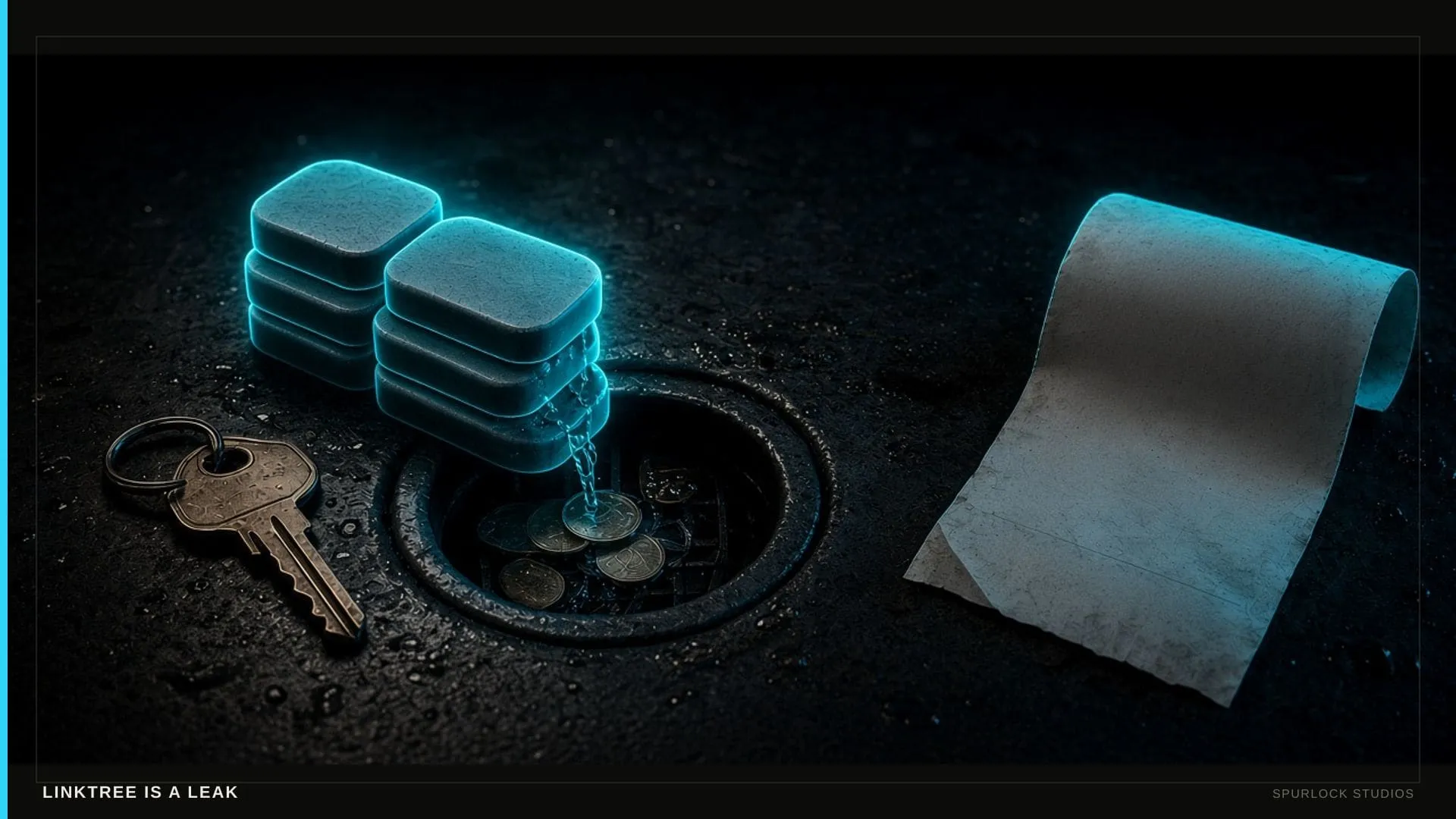
 Linktree is a leak — build the house
Spotify does not send you the fan’s email. Instagram rents the following. Linktree is a hallway with no register. The House is the owned room: site, membership, checkout, follow-up.
 Websites
 The shop site that answers the phone
A Midwest shop does not lose the job to a prettier hero. It loses the job to whoever looks real and picks up. Here is what the site has to do on a Saturday.
 Websites
 A media kit the brand can steal in sixty seconds
Influencers need a brand-safe /media or /kit with rates and demographics you can stand behind — not a Google Doc with dead links. This is not a booker EPK.
 Websites
 Creator Site or Business Site for the house?
Creator Site ($3,500) is tour, listen, join, buy. Business Site ($8,000) is the register. Pick after the $1,500 sprint — not before you have seen the house.