Stock Photos Are Fine Until They’re Doing the Selling
Use real photography where trust sells — hero, about, work, and proof pages — and keep licensed stock for texture surfaces that never close a deal alone.
William Spurlock Founder — Spurlock Studios Updated 20 MIN
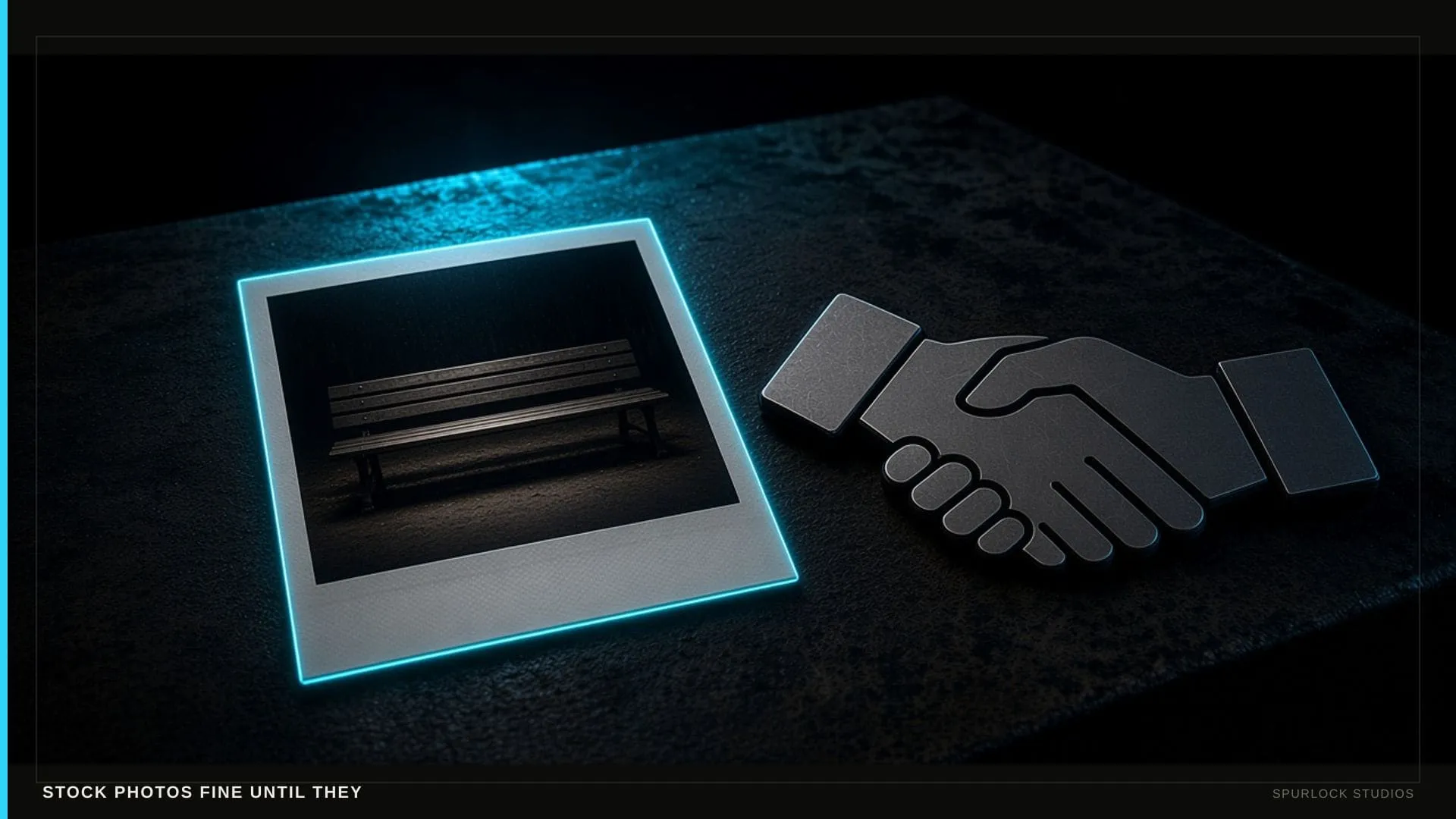
Stock photos are fine until they are doing the selling. If the image has to prove you exist, show your craft, or make a stranger trust a phone call, generic stock loses. If the image is atmosphere behind copy that already carries the argument, licensed stock — or a carefully chosen texture — can survive. Triage by page job, not by a purity lecture about authenticity. This spoke sits under Websites That Feel Like Films.
The short answer
- Real photos own hero, about, work/portfolio, and local-service proof.
- Stock survives on blog headers, abstract process diagrams, and low-stakes texture.
- Phone photos beat stock when they show your truck, stage, product, or people — if lit and cropped for the web.
- AI imagery is useful for mood boards and abstract textures; it fails for trades proof and artist identity.
- Brief a half-day shoot around CMS crops, not a fashion lookbook.
Which pages must show the real business?
Ask one question per page: If this image were replaced with a competitor’s stock library, would a buyer notice? If yes, that page needs real photography.
Nielsen Norman Group’s eyetracking work draws the same line from the other side of the glass: people scrutinize photos that carry information — products, real faces — and ignore decorative “feel-good” pictures used to jazz up a layout. A hero that could belong to any studio is decoration. A hero that could only be yours is content.
| Page / surface | Photography rule | Why |
|---|---|---|
| Homepage hero | Real brand media | First trust hit; stock reads as rented identity |
| About / team | Real people | Stock “team” photos destroy credibility on contact |
| Work / case studies | Real deliverables or process | Proof is the product — see case study pages that sell |
| Services (trades) | Real job sites, trucks, before/after | Local buyers compare to Google photos |
| Artist EPK / press | Real stage and studio | Bookers and press already know fake when they see it |
| Blog / notes headers | Stock or illustration OK | Rarely the closer |
| Legal / policy / utility | Optional or none | Do not spend shoot budget here |
Pair the fold with that rule. The one dominant visual above the fold should be brand-owned media, not a marketplace smile. Atmosphere can live in scene two.
Page-job checklist:
- Homepage hero would still be recognizable if the logo were cropped out
- About page would survive a LinkedIn comparison
- Work grid shows this studio’s output, not a lifestyle catalog
- Service pages would survive a Google Business Profile comparison
- Blog covers are labeled in the CMS as non-proof so editors do not promote them into the hero
What does trust research say about stock vs real photos?
This is not a taste argument. Three primary sources keep landing on the same split: real people and real premises raise belief; generic pictures do less; empty pages do least.
BrightLocal’s consumer-panel study asked more than 1,600 U.S. respondents which mocked-up local site they trusted, changing only the photo. A genuine owner image won 46% of choices, a generic product or office image 33%, and no image 21%. In a plumber follow-up that pitted a real owner against an obvious clip-art / stock plumber, 64% put more trust in the real photo. Face-to-face trades — anyone you invite into a house — showed the wider gap.
Stanford’s Web Credibility guidelines, drawn from three years of research with more than 4,500 people, put the same idea in operator language: show that a real organization and real people stand behind the site. An office photo and a physical address are listed as credibility moves, not decoration. Visual design should match the site’s purpose — a film-grade artist site and a trades proof site both need honesty, in different lighting.
CXL’s write-up of stock versus real photography reports a Marketing Experiments test where visitors who saw a real customer were 35% more likely to sign up than visitors who saw the top-performing stock treatment. Treat that as one reported test, not a universal lift. The useful part is the mechanism: a face that exists elsewhere as a marketplace file can inherit every scam and every competitor that already rented it.
| Source | What it measured | What to take |
|---|---|---|
| Nielsen Norman Group | Eyetracking on informational vs decorative images | Real people and products get scrutiny; fluff gets skipped |
| BrightLocal | 1,600+ local-site trust choices | Owner photo beats generic; generic still beats empty |
| Stanford Web Credibility Project | 4,500+ people, 10 guidelines | Show the real organization and the real people |
| CXL / Marketing Experiments | Reported signup test, real customer vs stock | One data point: the real face won that test |
What I do not take from this: “never buy stock.” BrightLocal’s generic images still beat a blank page. NN/g is against fluff, not against a licensed texture behind type. The research punishes stock that pretends to be proof.
Where stock is still acceptable
Stock earns a seat when it never pretends to be your receipt.
- Background textures and abstract light for UI chrome
- Iconographic or diagrammatic scenes that explain a process
- Blog covers when the post is educational, not a case study
- Temporary placeholders while a shoot is scheduled — labeled as temporary in the CMS if editors might forget
Rules that keep stock from lying:
- Never use a stock face as “your team.”
- Never show a stock job site as “our install.”
- Never put stock musicians on an artist site unless the art direction is openly illustrative.
- Prefer empty spaces, tools, and materials over smiling strangers.
- Reverse-search any face before it goes near a testimonial or about block.
| Surface | Stock OK? | Condition |
|---|---|---|
| Hero | No | Identity has to be owned |
| About / team | No | Faces are receipts |
| Work / case study | No | Proof cannot be rented |
| Process diagram | Yes | Must read as diagram, not documentary |
| Blog header | Yes | Not a case-study cover |
| Texture / grain / light leak | Yes | No implied people or jobs |
| Placeholder during production | Yes | CMS flag + kill date |
A licensed concrete floor, a paper texture, or a night-sky still can serve a cinematic site. A licensed “diverse standup meeting” cannot. The difference is whether a stranger would believe the picture happened to you.
How do you license stock without turning it into a lie?
Legal clearance and trust are different jobs. You can be fully licensed and still look rented.
Adobe Stock’s license terms split the library into commercial assets and “Editorial Use Only.” Editorial files are for newsworthy or public-interest context. They are not for ads, promotions, endorsements, or commercial blogs — even on an Extended license — unless you get separate written consent. A Standard commercial license does allow website posting with no view cap, which is why stock is fine for a blog header. It is not a permission slip to caption a stranger as staff.
| License class | Typical brand-site use | Hard no |
|---|---|---|
| Standard commercial | Texture, blog, abstract process | Merchandise whose value is the photo |
| Extended / enhanced | High-volume print or resale contexts | Still not a fake team |
| Editorial use only | News-style commentary, if you credit it | Homepage, ads, “our crew,” product shots |
| Unlicensed Google grab | None | Anywhere |
License checklist before an editor hits publish:
- File is commercial, not editorial, if the page sells
- Invoice or seat license is stored with the asset
- No recognizable person is labeled as staff, client, or talent
- No competitor’s job site, truck, or storefront is in frame
- Credit line added if the license requires it (editorial always does)
- Reverse image search is clean enough that the face is not a meme
If you cannot pass that list, the photo is doing selling work it was not hired to do. Swap it for a texture or wait for the shoot.
How to brief a half-day brand shoot for the web
A web shoot is not a magazine day. You need hero-capable frames and CMS-safe crops. I have shipped hundreds of production sites; the shoots that survive are the ones briefed against field names, not against a mood board that dies in Figma.
Checklist for the brief:
- List the pages that need real media (hero, about, 3–6 work proofs, 2–4 service proofs)
- Write aspect ratios: full-bleed hero (often 16:9 or wider), square for cards, vertical for mobile crop tests
- Name must-have subjects: storefront, truck, product close-ups, stage, hands at work, team (optional)
- Ban props that date the brand in six months unless that is the point
- Schedule 20 minutes of “ugly useful” shots: equipment labels, paperwork desk, loading dock — trades trust lives here
- Deliver selects with filenames that match CMS fields (
hero-home-01,about-team-02) - Spec long-edge sizes, color profile, and selects vs outtakes in the SOW
Half-day order of operations I use:
- Exterior / identity establishing shots while light is good
- Hero candidates against the brand’s real environments
- Process and detail for service or craft pages
- People last, once everyone is warmed up and wardrobe is consistent
| Deliverable | Why it is in the SOW | Failure if omitted |
|---|---|---|
| Hero long-edge 2400–3200px | Fold is usually the LCP image | Soft, upscaled JPEG in a 5-figure layout |
| Alternate hero | Seasonal swap without a second shoot | Homepage stale in month four |
| Card crops | Work index and service grids | Editors invent ratios |
| Vertical mobile test | Center-weighted crop on phones | Subject decapitated on iPhone |
| Color-managed selects | Consistency across a dozen pages | About page looks like a different company |
Tell the photographer the crop will be ruthless. Fashion-lookbook frames with faces at the edge die on a mobile hero. Put the subject in the safe center and leave negative space for type.
What if your product is hard to photograph?
Services, software, and music all dodge the camera. Photograph the evidence instead of faking the product.
| Business type | What to shoot | What not to fake |
|---|---|---|
| Trades / SMB | Trucks, crews, completed installs, before/after pairs | Stock suburban kitchens as “your job” |
| Studio / agency | Screens in context, printed comps, workshops, client spaces (with permission) | Generic open-office stock as “our team” |
| Software / SaaS | Real UI in device frames, operator setups, support rituals | Abstract “dashboard holograms” as product proof |
| Musicians | Stage, rehearsal, writing desk, merch, tour van | Marketplace concert crowds that are not yours |
For music sites, identity is the merch. A Foxtide or Arkayla-shaped homepage fails if the hero could be any indie band’s stock night. Own the silhouette, the lighting grammar, and the faces.
Evidence list when the “product” is invisible:
- The room where the work happens
- The tool or instrument in a hand that belongs to the brand
- The artifact a buyer can recognize (install, package, setlist, UI)
- One establishing frame that locates the business in a real place
- Written permission for any interior that is not yours
If you cannot shoot those five, you do not have a photography problem yet. You have an access problem. Book the access, then the camera.
When are phone photos enough — and when do you hire?
Phone photos are good enough when:
- The subject is clearly yours (your truck number, your stage, your product SKU)
- You control light (overcast outdoor, window light indoor, no yellow kitchen bulbs on skin)
- You shoot more frames than you need and crop ruthlessly for the CMS
- Someone with an eye kills the weak frames before they go live
Hire a pro when:
- Hero media must carry a five-figure brand site
- You need consistent color and lighting across a dozen pages
- You cannot get access to real environments without production help
- Previous DIY photos made the site look unfinished next to competitors
| Situation | Phone | Hired shooter |
|---|---|---|
| Three recent trade jobs, daylight | Yes | Optional polish later |
| Artist homepage that has to feel like a film | Rarely | Yes |
| Team of eight, mixed wardrobe, mixed rooms | Risky | Yes |
| Blog header while you wait | Yes, or stock | Waste of day rate |
| Before/after that will be advertised | Only if honest and sharp | Yes if the claim is the offer |
Cheap failure mode: paying for a shoot, then uploading JPEGs at phone resolution into a 2400px hero slot. Spec the deliverables. A second failure mode is the opposite: waiting a year for a “real” photographer while the live site sells with a stock grin. Phone the three proofs this week. Book the half-day for the hero.
Phone protocol I actually send clients:
- Shoot in the highest-resolution still mode, not a screenshot of a story
- Hold the camera still; burst if the subject moves
- Take one wider than you think, then one tighter
- Kill anything with mixed color temperature on faces
- Export a full-resolution original and a web-sized derivative — never only the derivative
Can AI-generated images replace a shoot?
Sometimes for texture. Almost never for proof.
AI imagery works for:
- Abstract atmosphere behind type
- Concept art while the real shoot is booked
- Illustration that is openly non-photographic
AI imagery fails for:
- Trades proof — buyers compare against Google Business photos of real vans and jobs
- Artist identity — fans and bookers know the face; a generated stand-in reads as evasion
- Team pages — generated coworkers are a trust cliff
- “Before and after” work claims — synthetic jobs are a liability
The FTC’s Endorsement Guides are blunt on the legal cousin of this problem: endorsements must be honest and not misleading, and they must reflect the honest opinion of a real endorser. A generated “customer” next to a testimonial is not a style choice. A fabricated before/after is a claim. 16 CFR § 255.2 treats consumer endorsements — including pictures that imply typical results — as representations you have to substantiate.
If you use generative tools for mood, keep them out of the conversion path. Treat them like stock: never as a receipt. Prefer real photography wherever the page’s job is to close a call, booking, or cart.
When AI is on the page, label it. The C2PA Content Credentials spec and the Content Credentials verifier exist so a file can carry provenance — including whether a generative tool was in the chain. Do not strip that metadata and then caption the frame as a job site.
| Use | AI OK? | Required honesty move |
|---|---|---|
| Mood / grain / abstract light | Yes | Do not caption as a photograph of the business |
| Storyboard for a shoot | Yes | Keep it in the project file, not the live hero |
| Team, talent, customer | No | Shoot or omit |
| Before/after | No | Real jobs, real permission |
| Product that does not exist yet | Illustration only | Say it is a render |
What resolution, LCP, and crop rules should the CMS enforce?
Editors ruin good shoots with the wrong crop. Encode the rules in field help text.
| Use | Typical long edge | Notes |
|---|---|---|
| Homepage hero | 2400–3200px | Test mobile crop; subject must survive a center-weighted crop |
| Card / grid | 1600px | Consistent ratio across the collection |
| Portrait / about | 1600px | Leave headroom; avoid chin-crop disasters |
| Blog cover | 1600–2000px | Can be stock if the post is not a case study |
web.dev’s LCP guidance sets the performance bar: aim for Largest Contentful Paint at or under 2.5 seconds for at least 75% of visits. On a cinematic homepage the hero is usually that LCP element. Do not loading="lazy" it. Mark it fetchpriority="high" if it is the fold image. Serving responsive images exists because a desktop-sized file on a phone can cost two to four times the data you needed.
CMS enforcement pattern:
- Required image + required alt text
- Help text: “2400×1600 preferred, under ~400KB after compression when possible”
- Reject optional “layout mode” fields that let editors invent new hero ratios
- Preview on mobile before publish
- Width and height (or aspect-ratio) reserved so the fold does not jump
Google’s image SEO documentation wants the same files discoverable: real <img> elements with a crawlable src, descriptive filenames, and alt that matches purpose. CSS background heroes look pretty in a template and disappear from image search. If the frame is the brand, put it in the HTML.
Accessibility is not a separate aesthetic. WCAG 2.2 Success Criterion 1.1.1 requires a text alternative that serves the equivalent purpose. 1.4.5 Images of Text tells you to set headlines in real type, not in a flattened JPEG, unless the presentation is essential (a logotype). A stock “SUCCESS” wordmark baked into a photo is a contrast and zoom problem wearing a slogan.
Alt-text rules I put in field help:
- Proof photos describe the actual subject (“Crew loading a branded van at dusk”), not a keyword pile
- Decorative textures get empty alt (
alt="") so a screen reader skips them - Team photos name the people if the page names them
- Never write “stock photo of smiling team” on a page that claims they are staff — if that sentence is true, the image is wrong
How many hero-capable images do you need?
Minimum set for a brand marketing site:
- One primary homepage hero (plus one alternate for seasonal swap)
- One about / studio establishing frame
- Three to six work proofs that can also crop to cards
- Two to four service or process frames if you sell services
- One quiet texture or still for campaign pages so you are not recycling the homepage forever
Artists often need fewer marketing frames and more press-usable verticals. Still: one undeniable homepage image beats twelve mediocre festival snaps.
Budget triage when money is tight:
- Hero + about first
- Then the three proofs that close deals
- Then blog and texture last — stock can cover those
| Budget | What you buy | What you refuse |
|---|---|---|
| Phone week | Hero-ish exterior, three proofs, truck or stage | Stock faces on about |
| Half-day | Hero, about, proofs, process, one alternate | Fashion extras you will never crop |
| Full day | Color-consistent set across the whole IA | A second mood that fights the first |
Count frames by URL, not by how many JPEGs landed on the card. If five files all crop to the same hero, you have one image. If three proofs cannot fill a work grid without repeating, you are not done.
How do trades businesses shoot proof without a big budget?
AllCity HVAC-shaped sites win when photos look like the company Google already shows on Maps — real trucks, real installs, real crew — not a national stock plumber. BrightLocal’s plumber scenario is the same instinct: the owner’s face beat the clip-art tradesman.
Google’s Business Profile photo guidelines want JPG or PNG, 10 KB to 5 MB, a recommended 720×720, a 250×250 floor, and images that are in focus, well lit, and representative of reality — “no significant alterations or excessive use of filters.” That last clause is the point. The website and the profile are one proof system. If the site is a catalog kitchen and Maps is a dented van, the buyer believes Maps.
Low-budget protocol:
- Pick three recent jobs the client is proud of
- Shoot exterior + one detail + one “finished room” per job
- Capture the truck with readable branding in at least two frames
- Get written permission where residential interiors are sensitive
- Upload the same honest set to the website and Google Business Profile so proof matches
Do not wait for a perfect portfolio day. Three honest jobs beat thirty stock bathrooms.
Trades shot list (half a Saturday):
- Truck, three-quarter, readable door mark
- Crew in actual kit, not matching “brand tees” bought that morning unless they are real uniform
- Job exterior that locates the work in a real street
- One detail only a practitioner would notice (plenum, flashing, sweep joint)
- Finished space without staging a lifestyle family
- Before frame if you still have it — same angle as the after
- Permission slip dated and stored with the files
Match checklist across site and profile:
- Same truck, same people, same class of job
- No stock bathroom as a stand-in “gallery”
- Cover photo on the profile would not embarrass the homepage
- New work uploaded after the next proud job, not once a year
Worked example: brand site photo map
Imagine a premium consumer brand launching a custom site on the /websites lane:
| Slot | Source | Reject if… |
|---|---|---|
| Home hero | Half-day shoot, product in real light | Looks like a catalog PNG on gray |
| About | Founder + workspace, phone OK if lit | Stock “collaborative team” |
| Case / work | Real packaging, retail, or process | Competitor-looking stock lifestyle |
| Blog | Licensed stock or illustration | Faces that could be mistaken for staff |
| Campaign landing | Shoot alternate or controlled still | Random AI face as “customer” |
Ship the site only when the selling surfaces clear the “real business” bar. Atmosphere pages can wait.
A music-site variant of the same map:
| Slot | Source | Reject if… |
|---|---|---|
| Home hero | Stage or studio frame that could only be this act | Festival crowd that is not theirs |
| About / bio | Writing desk, merch table, van, faces | Marketplace “band in alley” |
| Dates / EPK | Press-usable verticals from the same night | Watermarked wire photos you do not own |
| Store | Real merch on a real body or table | Generic hoodie ghost mannequin only |
| Journal | Texture, ticket stub, travel still | Stock crowd as “last night’s show” |
A trades variant:
| Slot | Source | Reject if… |
|---|---|---|
| Home hero | Truck + one finished job | National stock plumber |
| Services | Before/after of this company’s work | Pinterest kitchen |
| About | Owner, phone-lit is fine | Clip-art coworker |
| Contact | Real shop or truck, plus NAP | Stock handshake |
The map is the brief. If a slot has no honest source, the page is not ready. Cut the slot or rewrite the section until the copy can stand without a fake picture.
Failure mode: the pretty stock homepage
What breaks: the site looks expensive in a Figma file and hollow on a sales call. Prospects compare the homepage smile to the LinkedIn team page and feel the gap. Local service buyers open Google photos, see a different truck, and call someone else. NN/g’s ignored “jazzed-up” photos are the polite version of this. The rude version is a buyer who feels lied to.
What it costs: wasted ad spend on a fold that cannot close, plus a second photography budget after the redesign. You also inherit every other site that licensed the same face. CXL’s reverse-search warning is the cheap version of that risk; a scam site using the same file is the expensive one.
What you do instead: delay launch one week, shoot the three proofs, and put stock back in the blog where it belongs. Bravery with a marketplace library is not a brand strategy.
Repair order when the live site is already stock-heavy:
- Kill stock faces on about, team, and testimonials this week
- Replace the homepage hero with the best honest phone frame you can get in seven days
- Book the half-day against the remaining selling URLs
- Relabel leftover stock as texture or blog-only in the CMS
- Sync the new proofs to Google Business Profile the same day they go live
Do not “refresh” by buying a more expensive stock pack. A nicer rented face is still rented.
Decision list before you spend
Use this before you book a photographer or buy a stock plan:
- Which URLs close revenue this quarter?
- Would stock on those URLs survive a skeptical five-second test?
- Can phone + good light cover those URLs in seven days?
- If not, book a half-day aimed at those URLs only
- Leave stock budget for non-selling pages
- Confirm the license class before an editor uploads
- Confirm the same proofs will appear on Maps
Film-grade sites are not “no stock ever.” They are honest about which frames carry the story. That is the same craft bar as Websites That Feel Like Films: composition and proof, not decoration.
Spend matrix:
| If this is true | Spend here | Do not spend here |
|---|---|---|
| The fold closes the call | Hero shoot | Another stock plan |
| About is the trust cliff | Real people or a real empty shop | “Team” marketplace pack |
| Work pages are the closer | Three honest proofs | Twelve weak extras |
| Blog needs covers this month | Licensed texture | A photographer day rate |
| Maps and the site disagree | Reshoot to match | A redesign that keeps the lie |
FAQ
Are phone photos good enough?
Yes when they clearly show your real people, places, and work, and you control light and crop. A sharp phone frame of your truck or stage beats a polished marketplace smile. Hire a pro when the hero must carry a premium brand system or you need color and lighting to stay consistent across many pages.
Can AI-generated images replace a shoot?
Not for proof. AI can fill abstract texture and concept art, but it fails for trades job evidence and artist identity where buyers recognize fakes instantly. Keep generated frames out of testimonials, team pages, and before/after claims — those are honesty problems, not style problems.
What resolution and crop rules should the CMS enforce?
Require hero-capable long edges (roughly 2400px+), alt text, and help text for aspect ratios. Lock components so editors cannot invent new hero crops that break mobile. Do not lazy-load the fold image; it is usually the LCP element and needs an eager, high-priority request.
How many hero-capable images do I need?
Usually one primary homepage hero, one about frame, and three to six work or service proofs. Alternates help for seasons; dozens of weak images do not. Count distinct crops that can survive the CMS, not the number of files on the card.
Should the about page ever use stock team photos?
No. Stock teammates are a trust failure. Use real people, a real workspace without faces, or rewrite the section until you have honest media. BrightLocal’s panel trusted a real owner over a clip-art tradesman; your about page is that test.
How do trades businesses shoot proof without a big budget?
Photograph three real recent jobs — exterior, detail, finished result — plus the branded truck. Match those frames on the site and Google Business Profile so proof is consistent. Written permission for residential interiors is part of the shoot, not an afterthought.
CTA
Need a brand site where the photography plan matches the conversion path, not a stock folder? Explore /websites or book a sprint at /contact?intent=websites-sprint.
What questions does this article answer?
- Are phone photos good enough?
- Yes when they clearly show your real people, places, and work, and you control light and crop. A sharp phone frame of your truck or stage beats a polished marketplace smile. Hire a pro when the hero must carry a premium brand system or you need color and lighting to stay consistent across many pages.
- Can AI-generated images replace a shoot?
- Not for proof. AI can fill abstract texture and concept art, but it fails for trades job evidence and artist identity where buyers recognize fakes instantly. Keep generated frames out of testimonials, team pages, and before/after claims — those are honesty problems, not style problems.
- What resolution and crop rules should the CMS enforce?
- Require hero-capable long edges (roughly 2400px+), alt text, and help text for aspect ratios. Lock components so editors cannot invent new hero crops that break mobile. Do not lazy-load the fold image; it is usually the LCP element and needs an eager, high-priority request.
- How many hero-capable images do I need?
- Usually one primary homepage hero, one about frame, and three to six work or service proofs. Alternates help for seasons; dozens of weak images do not. Count distinct crops that can survive the CMS, not the number of files on the card.
- Should the about page ever use stock team photos?
- No. Stock teammates are a trust failure. Use real people, a real workspace without faces, or rewrite the section until you have honest media. BrightLocal’s panel trusted a real owner over a clip-art tradesman; your about page is that test.
- How do trades businesses shoot proof without a big budget?
- Photograph three real recent jobs — exterior, detail, finished result — plus the branded truck. Match those frames on the site and Google Business Profile so proof is consistent. Written permission for residential interiors is part of the shoot, not an afterthought.
Last reviewed
Keep reading.
 Websites
 Websites That Feel Like Films: Design Systems That Convert Without Looking Templated
Cinema-grade brand sites that still convert: one fold job, motion that survives phones, and stacks that ship without looking like every other template site.
 Websites
 How many fields should a contact form have
Default to 3–5 fields that change the reply: name, email, intent, and one qualifier. Extra questions belong on a second step after they start — not first.
 Websites
 When should a small business redesign their website
Redesign when conversion collapses, mobile fails, the CMS locks, the offer changed, or trust went stale — not because the site turned three years old.
Websites
 Websites
 Linktree is a leak — build the house
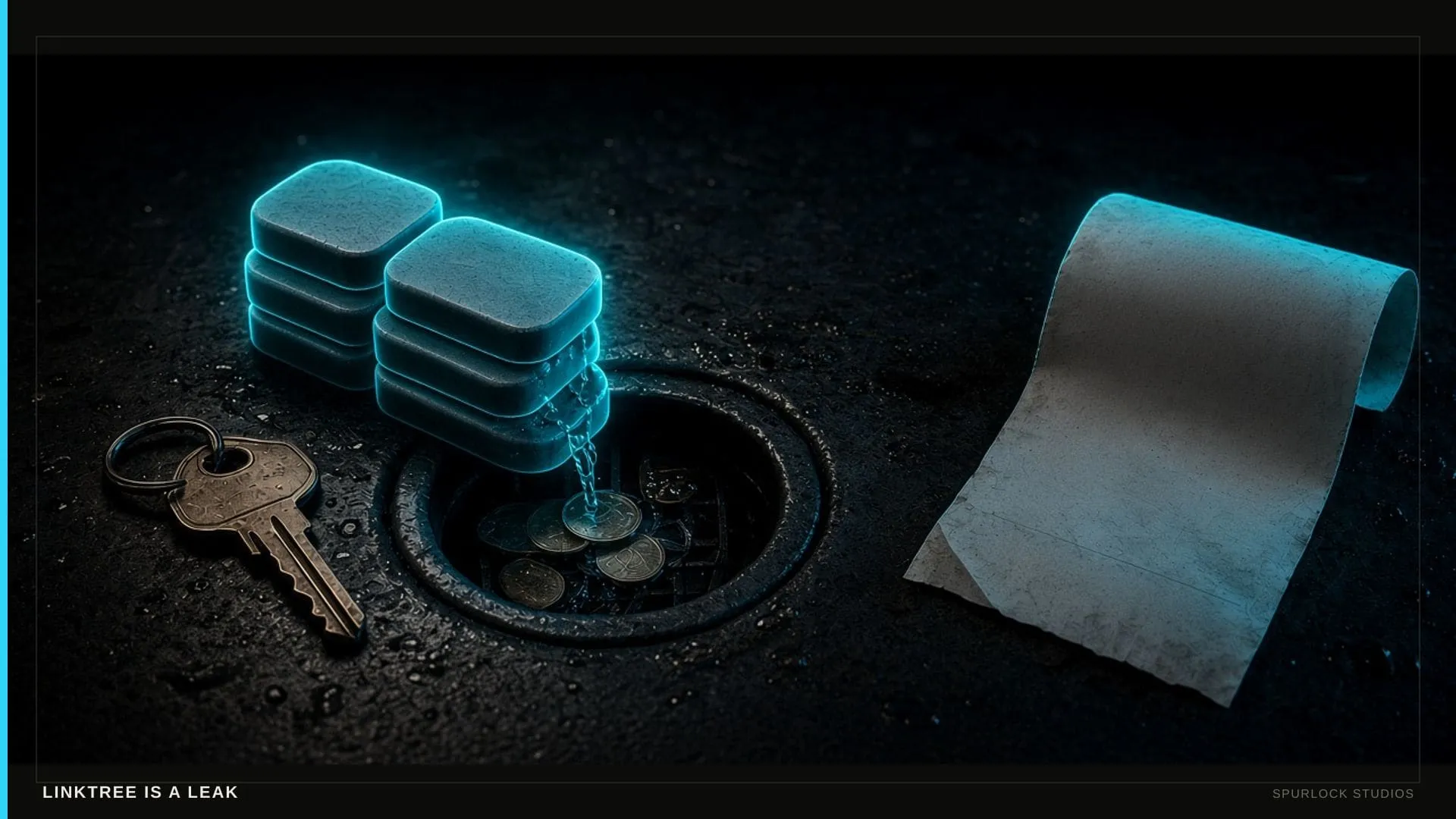
Spotify does not send you the fan’s email. Instagram rents the following. Linktree is a hallway with no register. The House is the owned room: site, membership, checkout, follow-up.
 Websites
 The shop site that answers the phone
A Midwest shop does not lose the job to a prettier hero. It loses the job to whoever looks real and picks up. Here is what the site has to do on a Saturday.
 Websites
 A media kit the brand can steal in sixty seconds
Influencers need a brand-safe /media or /kit with rates and demographics you can stand behind — not a Google Doc with dead links. This is not a booker EPK.
 Websites
 Creator Site or Business Site for the house?
Creator Site ($3,500) is tour, listen, join, buy. Business Site ($8,000) is the register. Pick after the $1,500 sprint — not before you have seen the house.